

Decolonising the world map, why, how to this matters for social development, and your immediate action act?
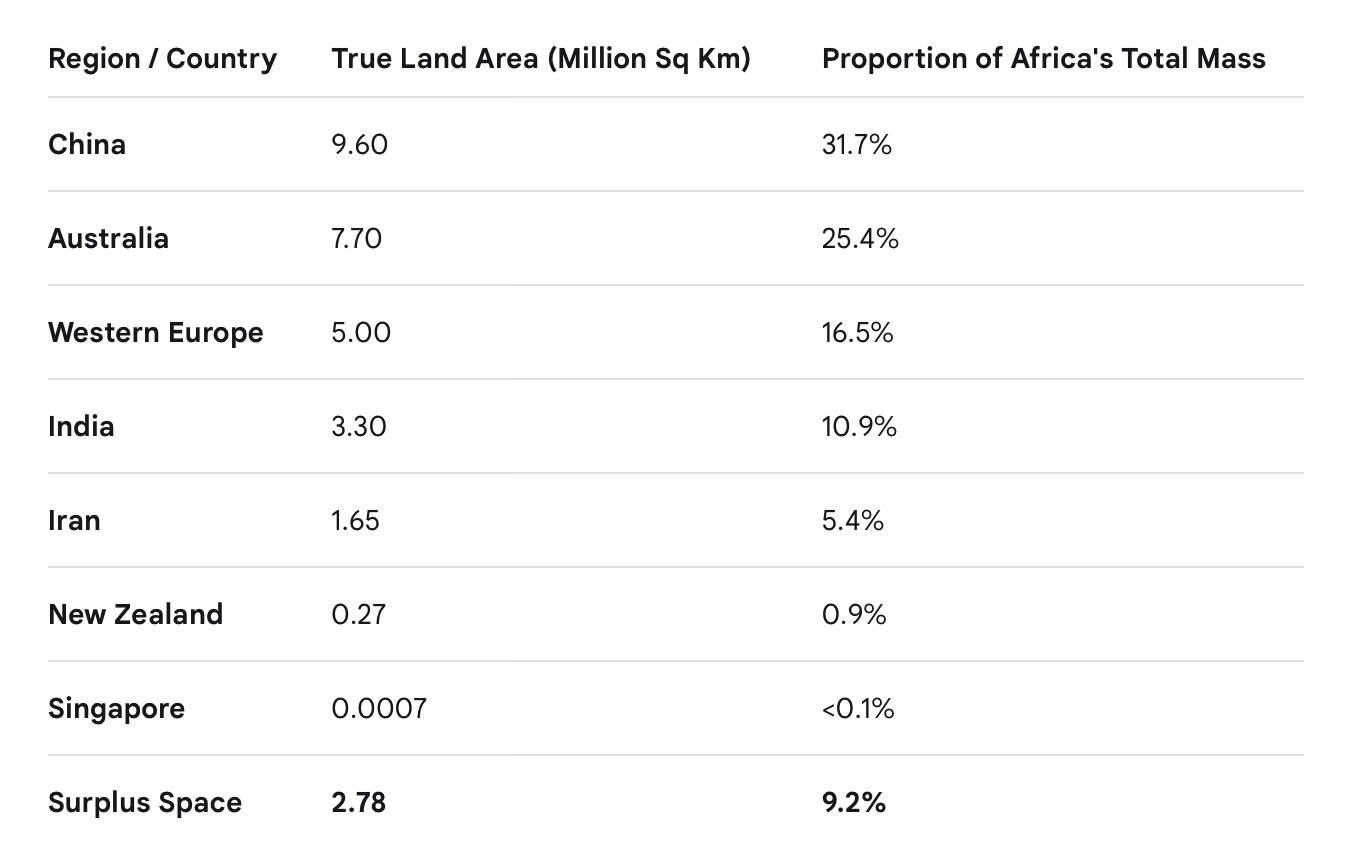
When we look at standard world maps, the immense scale of Africa is almost always lost to distortion. This volumetric breakdown reveals the astonishing reality: the African continent is a massive geographical container capable of swallowing several of the world’s largest superpowers simultaneously. By mapping out landmasses by their actual surface area rather than forcing rigid shapes to overlap on a flat map, we can see that China, Australia, Western Europe, and India combined take up nearly 85% of Africa’s total footprint. Even after packing in substantial nations like Iran, New Zealand, and Singapore, a massive surplus of empty space remains untouched—a stark reminder of just how much traditional cartography skews our perception of the Global South.
Here is how these global territories stack up against Africa’s total capacity of 30.3 million square kilometres:
Do a detailed reading of this topic from our blog post Restoring the balance: why the United Nations (UN) adopted the Togo-Equal Earth Projection (TEEP) world map.
New book (external)
A reader of Owia Bulletin, Daniel Adeagbo, recently co-authored a book titled Future-ready Social Worker. Use the URL to access the table of contents list, forward and to buy the digital book. The book has content on decolonising, indigenising social work in Africa, and cited significantly more African literature. It is a 1-hour read!
Successful Wazee Day 2026
Wazee Day 2026, held on 9 October under the theme “The Age of Longevity: Rethinking Systems for Longer Lives,” was a success. The event brought together participants from across Africa and beyond to learn, share, and develop strategies for older persons in Africa. A full report, including key points from the presentations by Prof Stephan Geyer (University of Pretoria, South Africa) and Dr Elizabeth Ajayi (Adekunle Ajasin University, Nigeria), is being finalised and will be published on the Mtandao website and in this newsletter. Our next collaborative event is Fundo yaUbuntu | Ubuntu Annual Lecture, with details to be posted soon.
Mtandao extend sincere thanks to the events Joint Coordinating Committee (JCC) (joint with and the Association of the Schools of Social Work in Africa, ASSWA) for their work in making Wazee Day possible. The JCC comprises Yvonne Tchaka Karekezi (Co-Chairperson) and Olabisi Adebawo from Mtandao and Dr Corlie Giliomee (Co-Chairperson), Susan Muchiri and Dr Wilkins Ndege Muhingi from ASSWA.
Vacancies and opportunities
We use the Ubuntu framework to categorise the roles we have aggregated for readers. The framework sees everything as interconnected and groups work according to five levels: family or familyhood (ukama), community or communityhood (ujamaa), societal or societyhood (ujamii), environmental or environmenthood (umvelo) and spiritual or spiritualhood (uroho). Ukama covers the extended and tribal family, not only parents and children. Ujamaa covers the collective life of a community. Ujamii covers the cultural, economic, political and global whole. Umvelo holds that people and the environment are one, and uroho holds that the spiritual, the environmental and the human exist together. A role can touch more than one level, so each vacancy below sits where the greater part of its work falls.
Family, familyhood (ukama)
Child protection officer: UNICEF, Ethiopia, closes 26/10/26, minimum bachelor’s degree, link
Protection assistant: Unique Care and Support Foundation, Nigeria, closes 20/10/26, minimum bachelor’s degree, link
Community, communityhood (ujamaa)
Social protection officers (multiple positions): Association of Women Living with HIV/AIDS in Nigeria, Nigeria, closes 18/10/26, minimum bachelor’s degree, link
Social and behaviour change officer: UNICEF, Mozambique, closes 21/10/26, minimum bachelor’s degree, link
Programme manager, community stabilisation: IOM, Somalia, closing date not stated, minimum master’s degree, link
Societal, societyhood (ujamii)
International project manager consultant: UN Women, South Africa, closes 16/10/26, minimum master’s degree, link
Communications intern, South Sudan citizens only: UNICEF, South Sudan, closes 18/10/26, minimum current university enrolment, link
Knowledge management consultant, gender equality team: UNICEF, Kenya (remote), closes 19/10/26, minimum bachelor’s degree, link
Prevention of sexual exploitation and abuse specialist, Kenya citizens only: UNFPA, Kenya, closes 19/10/26, minimum master’s degree, link
Education officer: UNICEF, Madagascar, closes 22/10/26, minimum bachelor’s degree, link
International team leader on a school dropout strategy: UNICEF, Central African Republic, closes 22/10/26, minimum master’s degree, link
National consultant on social worker training, Tunisia citizens only: UNICEF, Tunisia (remote), closes 23/10/26, minimum master’s degree, link
National consultant on a school dropout strategy: UNICEF, Central African Republic, closes 23/10/26, minimum master’s degree, link
Monitoring and evaluation officer: UNICEF, Madagascar, closes 23/10/26, minimum master’s degree, link
Innovation officer: UNICEF, Tanzania, closes 23/10/26, minimum bachelor’s degree, link
Programme management specialist, Mali nationals and residents only: UN Women, Mali, closes 25/10/26, minimum master’s degree, link
Chief of education: UNICEF, Angola, closes 26/10/26, minimum master’s degree, link
Environmental, environmenthood (umvelo)
Environmental and social safeguards officer: UNICEF, Central African Republic, closes 2/11/26, minimum bachelor’s degree, link
Spiritual, spiritualhood (uroho)
No roles this week.
What you can use from Mtandao for these positions
Roles: list any role you hold in Mtandao on your CV, for example member of the Mtandao ethics committee. Details about joining Mtandao and be part of its several committees, groups and teams are here.
Training: mention courses you have completed, for example the Ethics Course
Events: include events you have attended, for example Wazee Day or the Women in Research event
Day of the African Child Students Conference: mention attending, presenting, reviewing abstracts or helping organise the conference, as this shows a direct commitment to children’s rights
Publications: add any work you have published, for example in the People Centred journal